
Event Videography in Washington DC and Northern Virginia: What to Expect

Most event planners book a videographer the same way they book a photographer: find someone with a decent portfolio, get a quote, confirm the date. Then the event happens, the footage comes back three weeks later, and it is fine. Watchable. Competent. But not the kind of video that makes anyone feel anything, or that gets shared, or that ends up in next year’s sponsorship deck.
That gap between fine and actually useful is almost always a planning problem, not a production problem.
If you are organizing an event in Washington DC or Northern Virginia and you want video coverage that works beyond the week it was shot, this is what you actually need to know.
It Starts Long Before the Day of the Event
Most clients do not realize that the conversation they have with a videographer two weeks before the shoot matters more than almost anything that happens on the day itself.
The DC event market is specific. A nonprofit gala at the Marriott Wardman Park runs differently from a federal agency summit near the Capitol or a product launch at a Tysons rooftop. Lighting conditions change. Venue audio systems vary wildly. Some rooms in the Rosslyn corridor have excellent house PA systems your videographer can pull a clean feed from. Others have sound setups that look professional until you actually listen back to the recording.
The team that asks for your run of show in advance, walks through the venue layout, and has an explicit conversation about where the audio is coming from will deliver something usable. The one that shows up day-of and figures it out on the spot probably will not.
The pre-production conversation should cover a few specific things. Where is each speaker being mic’d? What time does the first session start and is there time to set up before doors open? Which moments on the program are non-negotiable? If the keynote speaker is only on for 20 minutes and it is the most important thing happening all day, your videographer needs to know that before the schedule, not when it is already in progress.
Nobody talks about pre-production in event videography. They should. It determines everything.
What Actually Happens on the Day
A crew that takes event videography seriously shows up at least 60 to 90 minutes before the first session. Not because they are trying to be impressive. Because setup, audio checks, camera positioning, and a quick walk of the room take time, and doing that while guests are arriving is not a setup for good work.
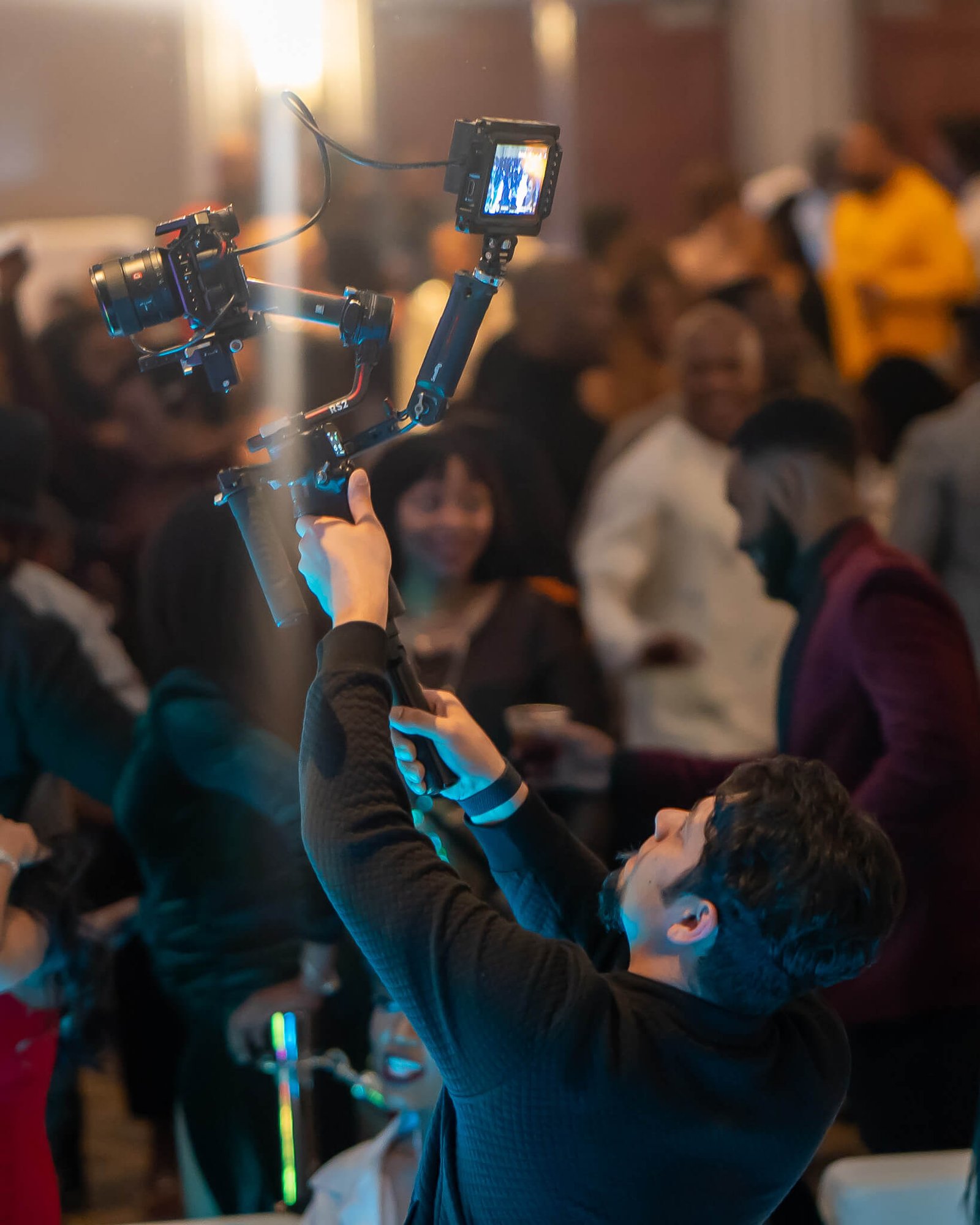
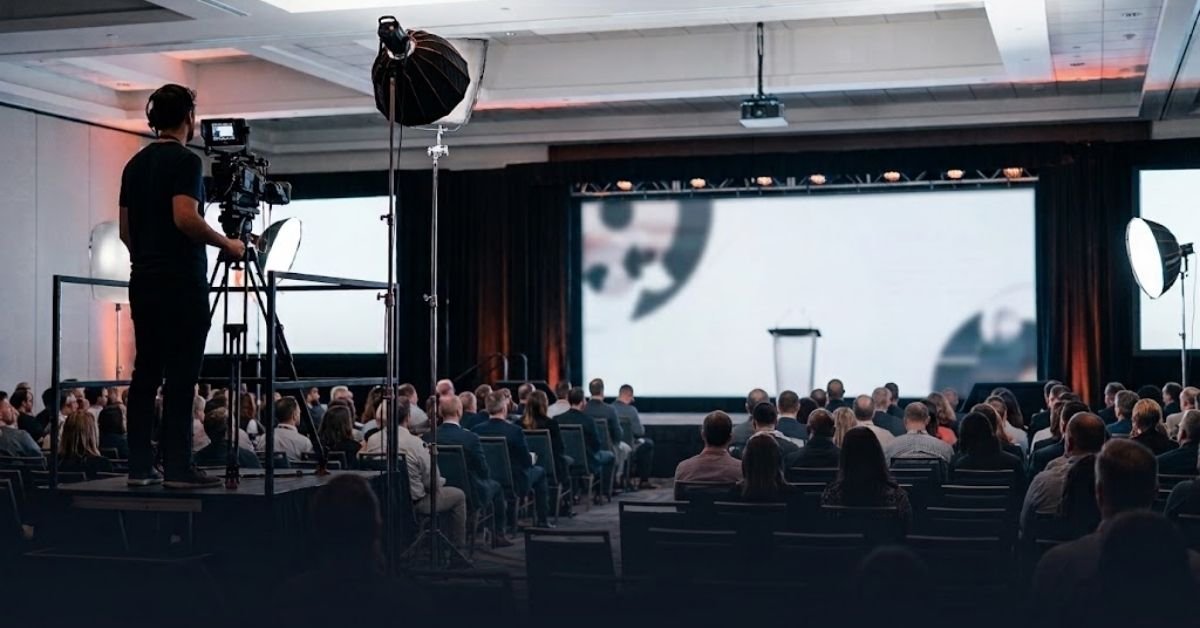
The camera approach depends on what you are shooting. A multi-day conference at the Walter E. Washington Convention Center with four breakout tracks running simultaneously needs a different plan than a 200-person gala in Arlington where the whole evening happens in one room. For anything with a main stage and a speaker, two cameras are the practical minimum: one locked on the speaker, one moving through the room to cover the audience, the atmosphere, and the details that make a highlight reel feel alive rather than like a lecture recording.
Audio gets captured separately from the camera. This is not optional if you want the footage to be usable. A wireless lavalier on the speaker, or a direct feed from the soundboard, gives you clean dialogue even when the room acoustics are working against you. If a production company has not mentioned audio sourcing before the day of the event, ask them about it directly. The answer will tell you a lot.
Good event videographers are also mostly invisible. Guests should not be aware of them in any active way. They move through the room with purpose and stay out of sightlines. If you are watching your event and thinking about the video crew, something has gone wrong.
What You Actually Walk Away With
Most clients are surprised by what they actually receive after an event shoot, usually because no one walked them through it before they signed.
The most common deliverable is a highlight reel. Usually two to four minutes, cut with music, designed to capture the energy and key moments of the event in a format short enough to share. This is what you post on LinkedIn the morning after, send to sponsors as part of a recap, or embed on your website as proof that the event happened and was worth attending. A good highlight reel does not just document. It makes someone who was not there wish they had been.
Full session recordings are a different product. If you are running a conference with keynote speakers and breakout panels that your members or stakeholders need access to after the event, those require a clean, unedited or lightly edited full-length recording of each session. These go on member portals, into post-event emails, and sometimes into grant reports or board presentations. They are not exciting to watch. They are not supposed to be. They are for people who need the content, not the experience.
Social media clips are a third category that often gets overlooked until after the fact. Think 30 to 90-second cuts: a specific quote from a speaker, a crowd moment, a piece of the program that works on its own. If you want these, plan for them in advance. Tell your videographer which speakers are most likely to say something quotable and make sure the audio coverage for those moments is prioritized.
Turnaround time is worth asking about explicitly before you book. For a standard highlight reel from a single-day event, two weeks is a reasonable expectation. Anything faster than that is a rush job, and some teams charge for it. Anything slower than three weeks for a straightforward event is worth asking about.
The DC and Northern Virginia Market Has Its Own Considerations
Event videography in Washington DC is not the same as event videography anywhere else in the country, and it matters if your production team knows that.
Federal and government-adjacent events often involve credentialing, building access protocols, and filming restrictions that a team without experience in that environment will not anticipate. Outdoor events on or near the National Mall require permits through the National Park Service. That is a specific process with its own lead time, and if your videographer has not navigated it before, you will find out the hard way.
The Northern Virginia side of the market, across Arlington, Alexandria, Fairfax, and Tysons, tends to run more corporate and association-focused events. These often need video content that serves multiple purposes at once: internal communications, external marketing, sponsor reporting, and sometimes recruitment. The coverage plan has to account for all of those use cases, which is a conversation that needs to happen before the shoot.
Venues across the corridor also vary significantly in what they provide and what they restrict. Crystal City conference properties tend to have solid connectivity and good house audio. Some of the older Georgetown venues do not. Knowing this in advance, based on actual experience filming in those rooms, is the kind of institutional knowledge that does not show up in a portfolio.
For organizations that need both live in-room coverage and remote audience access, live event production involves a separate streaming infrastructure running alongside the recording setup. These are two different systems. A stream going down should not affect the recording. If your production team is running both from the same laptop, that is a problem.
Event coverage for corporate clients in the DMV often extends into content that lives well beyond the event itself. According to Wyzowl’s State of Video Marketing research, over 90 percent of businesses using video report a positive return on investment. For corporate organizations running annual summits, conferences, or leadership retreats, the event video often becomes the most-used piece of content produced all year.
What Separates a Good Event Videographer from an Average One
The portfolio matters, but it does not tell you everything. A reel full of beautiful footage from weddings and music videos does not tell you how someone handles a six-session conference with three rooms running simultaneously and a keynote speaker who went 15 minutes over.
Ask what their backup plan is when equipment fails. Any experienced crew has an immediate answer because something has failed on a shoot before and they have learned from it. If the answer is vague, keep looking.
Ask specifically who is editing the footage. Teams that outsource post-production to freelancers often have less control over turnaround time, consistency, and the final look of the video. An in-house editor means one standard applied across every deliverable, and someone accountable when revisions are needed.
Ask for itemized pricing. Not a package price that lumps everything together, but a line-by-line breakdown of what you are paying for. Number of camera operators. Hours of coverage. What is included in post-production. How many revision rounds. Whether travel within the DMV is included or billed separately. Vague pricing is a setup for a conversation you do not want to have after the footage has been delivered.
And ask what happens if something goes wrong on the day. Not because you expect it to. Because how a team answers that question tells you more about how they operate than anything in their reel.
Frequently Asked Questions
How far in advance should I book event videography in Washington DC?
For conferences, galas, and multi-session corporate events, four to eight weeks is the target. The DC and Northern Virginia market is busy through most of the year, with peak demand in spring and fall when the association and government conference calendar fills up. The earlier you confirm, the more time there is for proper pre-production planning, which is where most of the value in a good event video gets built.
How much does event videography cost in the DMV area?
Scope drives price more than anything else. A single-camera corporate event with a basic highlight reel typically starts around $1,500 to $2,500. A multi-camera conference with full session recordings, social media clips, and a polished highlight reel can run from $5,000 to $15,000 or more depending on how many hours of coverage, how many cameras, and how much post-production is involved. Ask for an itemized quote so you know exactly what each line item covers.
What is the difference between a highlight reel and a full session recording?
A highlight reel is an edited piece, usually two to four minutes, cut with music and designed to capture the feel and key moments of the event. It is what you share. A full session recording is a clean capture of a specific keynote or panel, usually unedited or lightly formatted, used for distribution to people who need the full content. Most organizations leaving an annual conference need both, and they are budgeted and planned for separately.
Do I need a permit to film at locations in Washington DC?
For commercial shoots in public spaces, particularly near or on the National Mall, permits are typically required and go through the National Park Service. The process has its own timeline and requirements. A production team with experience filming across the DC area will handle this for you, but it is worth asking explicitly during your first conversation with any potential vendor.
Can event video content be repurposed for marketing after the event?
It is one of the most efficient ways to generate content. One well-produced event shoot can yield a highlight reel, speaker clips, testimonial cuts, social media content across multiple platforms, and a long-form recap piece. The key is planning the shot list in advance to make sure the right moments are captured with repurposing in mind. This is a conversation to have during pre-production, not after the footage is already in the edit.
What should I do if my event has both in-person and remote attendees?
Live streaming for hybrid events requires a separate setup from the recording equipment. You need a dedicated encoder, a reliable upload connection at the venue, and someone managing the stream in real time during the event. Some venues in the DC area have strong internet infrastructure built in. Others do not, and a professional crew will know which is which and bring solutions accordingly. Make sure whoever you book has actually run hybrid productions before, not just filmed events where they also pressed record on a stream.
Planning an Event in DC or Northern Virginia?
The video content from your event is going to outlast the event itself by months or years. Getting it right is not about finding the cheapest crew or the flashiest reel. It is about finding a team that asks the right questions before the day, executes cleanly during it, and delivers something you can actually use when it is done.
Echo Prime Media works with corporate organizations, nonprofits, and associations across Arlington, Alexandria, Tysons, Fairfax, Bethesda, and Washington DC. Every engagement starts with the same conversation: what does this event need to produce, and how do we plan for that from the beginning?
Talk to the Echo Prime team about your event and get a clear quote.
Echo Prime Media is a video production company based in Northern Virginia, working with clients across Arlington, Alexandria, Fairfax, Tysons Corner, Bethesda, and Washington DC.